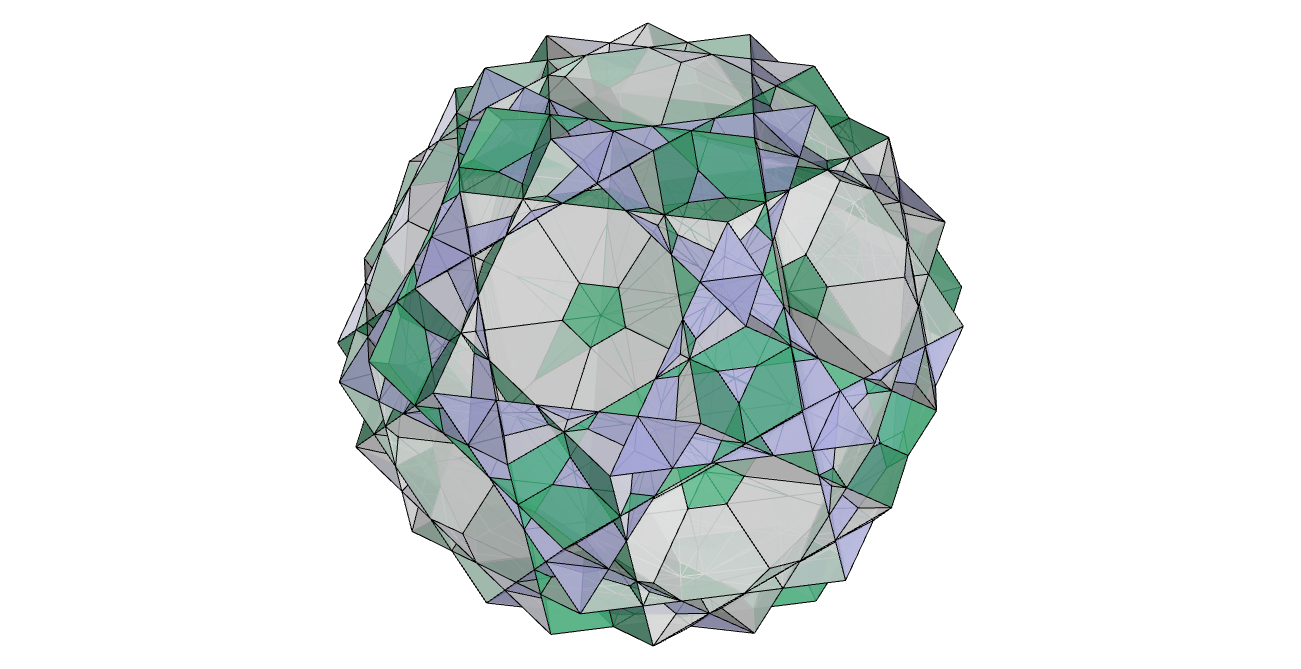
Quasiregular polyhedra are isogonal and isotoxal; their vertex figures are equal, cyclic, and equiangular [1]. Different face types surround each face, and all dihedral angles are equal. Every quasiregular polyhedron has a system of equatorial polygons. A great circle of the circunsphere inscribes each of these equatorial polygons.
Only two convex quasiregular polyhedra exist: the cuboctahedron (eight triangular and six square faces) and the icosidodecahedron (twenty triangular and twelve pentagonal faces). Their equatorial polygons are, respectively, regular hexagons and regular decagons. The cuboctahedron and the icosidodecahedron are two of the thirteen Archimedeans, and their names explain from which polyhedra they derive from rectification:
- the vertices of the cuboctahedron are the edges’ midpoints of the cube or the octahedron;
- the vertices of the icosidodecahedron are the edges’ midpoints of the dodecahedron or the icosahedron.
Cuboctahedron, CO, from the cube and from the regular octahedron
Icosidodecahedron, ID, from the regular dodecahedron
[1] Coxeter, H. (1973).Regular Polytopes. New York: Dover Publications. p. 17.
* The software used is Rhinoceros (version 6.0)
 moving geometry