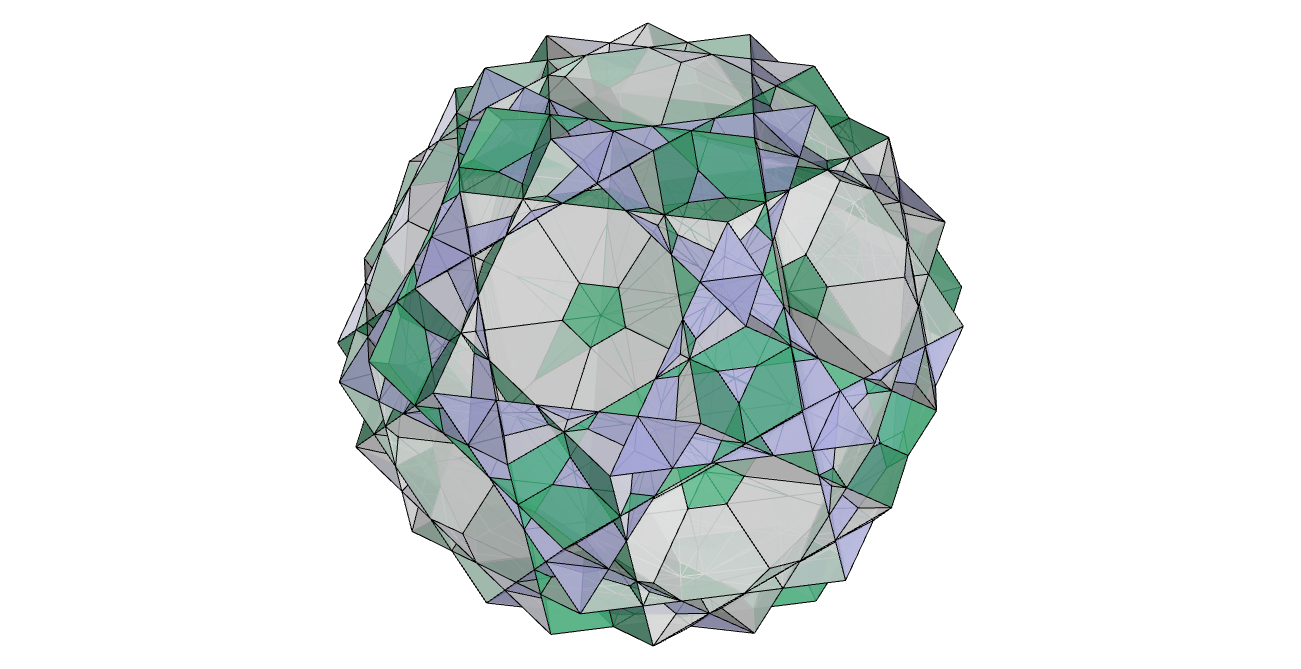
this page gathers interactive 3D models of the polyhedra described by Daniele Barbaro (1514–1570) in his 1568 treatise La Pratica della Perspettiva. each model can be rotated, zoomed, and examined in detail, making Barbaro’s geometric constructions accessible in a way that is not possible from the printed figures alone. for a deeper treatment of the mathematical and historical aspects, as well as the methodology behind the reconstructions, the page links to my 2023 publications on Barbaro’s polyhedra. the links below lead to a brief description of each polyhedron, an interactive 3D model, and an STL file for those who wish to 3D print it; the models are approximately 100–110 mm in diameter and were prepared for stereolithographic printing.
Daniele Barbaro’s convex non-uniform polyhedra
Viana, Vera. “Non-Uniform Polyhedra Described by Daniele Barbaro.” In Daniele Barbaro and the University of Padova, edited by Kim Williams and Cosimo Monteleone, 109–37. Cham: Springer Nature Switzerland, 2023. https://doi.org/10.1007/978-3-031-29483-9_6.
materializing Daniele Barbaro’s creativity with 3D printing
Viana, Vera. “Materializing Daniele Barbaro’s Creativity with 3D Printing.” In Proceedings of Bridges 2023: Mathematics, Art, Music, Architecture, Culture, 313–320. Phoenix: Tessellations Publishing, 2023. https://archive.bridgesmathart.org/2023/bridges2023-313.pdf
in this webpage:
- chapter XVI: rectified truncated octahedron
- chapter XVIII: rectified truncated icosahedron
- chapter XIX: truncated pentakis dodecahedron
- chapter XX: twice-truncated icosahedron
- chapter XXII: twice-truncated octahedron
- chapter XXV: truncated rectified truncated octahedron
- chapter XXXIV: elongated truncated octahedron
- chapter XXXIV: chamfered ccube
- chapter XXXIV: no name yet
- chapter XXXIV: truncated rectified truncated icosahedron
chapter XVI (1568: 90–93): rectified truncated octahedron
Barbaro (1568, 91) explains that, by dividing into two equal parts the edges of the body of 6 squares and 8 hexagons (the truncated octahedron) and taking away the solid angles where these parts finish, he obtained another body of 24 triangles, 6 squares and 8 hexagons, which is the rectified truncated octahedron.
Wentzel Jamnitzer (1507/08–1585) drew a similar body on Perspectiva Corporum Regularium (1568, Plates B. II and B. IV], published in the same year as Pratica della Perspettiva. there is no evidence that Barbaro ever knew Jamnitzer’s book, but since their approaches to solid geometry were so different, they probably found the rectified truncated octahedron independently.
download this STL file if you wish to 3D print this model.
chapter XVIII (1568: 97): rectified truncated icosahedron
the rectified truncated icosahedron is obtained when the edges of the truncated icosahedron (with 20 hexagonal and 12 pentagonal faces) are divided equally and then truncated again the same way, producing a new polyhedron with triangular, pentagonal, and hexagonal faces.
in Barbaro’s treatise the printed net is visually misleading: the triangles and hexagons are regular, and the drawing suggests a regular tiling, although in the actual solid the triangles are only approximately regular while the pentagons and hexagons are regular and share their edges with the shorter and longer triangle edges, respectively. only part of the full net is shown, yet Barbaro remarks that the resulting body is very beautiful, despite lacking a natural stable resting position.
modern authors classify this solid as a “near‑miss” Johnson solid and as a symmetrohedron, since it is convex, has many regular faces with icosahedral symmetry, but fails to only have regular faces.
this 3D model reconstructs Barbaro’s rectified truncated icosahedron, making its non‑uniform geometry and symmetries easier to inspect than in the original woodcut. download this STL file if you wish to 3D print this model.
chapter XIX (1568: 98): truncated pentakis dodecahedron
description to be added soon.
download this STL file if you wish to 3D print this model.
chapter XX (1568: 99): twice-truncated icosahedron
description to be added soon.
download this STL file if you wish to 3D print this model.
chapter XXII (1568: 101): twice-truncated octahedron
description to be added soon.
download this STL file if you wish to 3D print this model.
chapter XXV (1568: 104): truncated rectified truncated octahedron
description to be added soon.
download this STL file if you wish to 3D print this model.
chapter XXXIV (1568: 111): “elongated” truncated octahedron
description to be added soon.
download this STL file if you wish to 3D print this model.
chapter XXXIV (1568: 111): chamfered cube
description to be added soon.
further details about the chamfered cube in modelling the chamfered cube.
download this STL file if you wish to 3D print this model.
chapter XXXIV (1568: 111): no name yet
description to be added soon.
download this STL file if you wish to 3D print this model.
chapter XXXIV (1568: 111): truncated rectified truncated icosahedron
description to be added soon.
download this STL file if you wish to 3D print this model.
references:
- Barbaro, Daniele. 2021. “Part III, Which Treats the Ways of Raising the Body from the Plan.” Translated by Kim Williams and Cosimo Monteleone. In Daniele Barbaro’s Perspective of 1568, edited by Cosimo Monteleone and Kim Williams. Cham: Birkhäuser. https://doi.org/10.1007/978-3-030-76687-0_6.
- Viana, Vera. 2023. “Materializing Daniele Barbaro’s Creativity with 3D Printing.” In Proceedings of Bridges 2023: Mathematics, Art, Music, Architecture, Culture, edited by Judy Holdener, Eve Torrence, Chamberlain Fong, and Katherine Seaton, 313–320. Phoenix, AZ: Tessellations Publishing. http://archive.bridgesmathart.org/2023/bridges2023-313.html
- Viana, Vera. 2023. “Non-Uniform Polyhedra Described by Daniele Barbaro.” In Daniele Barbaro and the University of Padova. DBSPA 2022. Trends in the History of Science, edited by Cosimo Monteleone and Kim Williams. Cham: Birkhäuser. https://doi.org/10.1007/978-3-031-29483-9_6.
- Jamnitzer, Wenzel. 1568. Perspectiva Corporum Regularium. W. Jamnitzer. Perspectiva Corporum Regularium. 1568. https://archive.org/details/gri_33125012889602/page/n79/mode/2up
 moving geometry