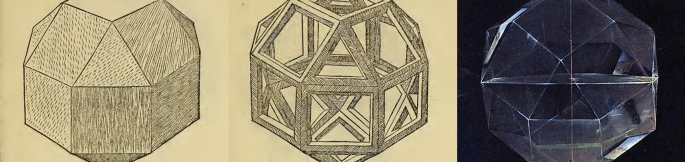
“Luca Pacioli’s Rhombicuboctahedron: Description, Construction, and Architectural Reception”, published in the Nexus Network Journal, examines the rhombicuboctahedron described by Luca Pacioli in his Divina proportione (1509) where the earliest known graphic representation of this polyhedron is shown. unlike his more detailed treatments of other solid bodies in this book, Pacioli provides only a concise account of how to derive it from the cube, while emphasizing its potential architectural utility.
this study reexamines Pacioli’s account to reconstruct the procedure he may have followed, drawing on textual analysis, Renaissance geometric practice, and comparisons with sixteenth-century mathematicians and artists. I assess algebraic, geometric, and model-based constructive possibilities in relation to other procedures discussed in Pars Prima. the paper also discusses the limited reception of the rhombicuboctahedron, evident in its small number of architectural applications throughout history.
while the full study is published as “Luca Pacioli’s Rhombicuboctahedron: Description, Construction, and Architectural Reception” is not open access, you can access the view-only version through this link provided by Springer: https://rdcu.be/ff6ed.
citation
Viana, Vera. “Luca Pacioli’s Rhombicuboctahedron: Description, Construction, and Architectural Reception.” Nexus Network Journal 28 (2026): 521–37. https://link.springer.com/article/10.1007/s00004-026-00885-9
abstract
The Divina proportione, first printed in 1509, contains the earliest known graphic representation of the rhombicuboctahedron. Unlike his more detailed treatments of other solid bodies in this book, Luca Pacioli provides only a concise account of how to derive it from the cube, while emphasizing its potential architectural utility. This study reexamines Pacioli’s account to reconstruct the procedure that he may have followed, drawing on textual analysis, Renaissance geometric practice, and comparisons with sixteenth-century mathematicians and artists. Algebraic, geometric, and model-based constructive possibilities are assessed in relation to other procedures discussed in Pars Prima. The paper also discusses the limited reception of the rhombicuboctahedron, evident in a small number of architectural applications.